News Release: Monday, October 14, 2024
The Federal Government’s international plea to “protect and
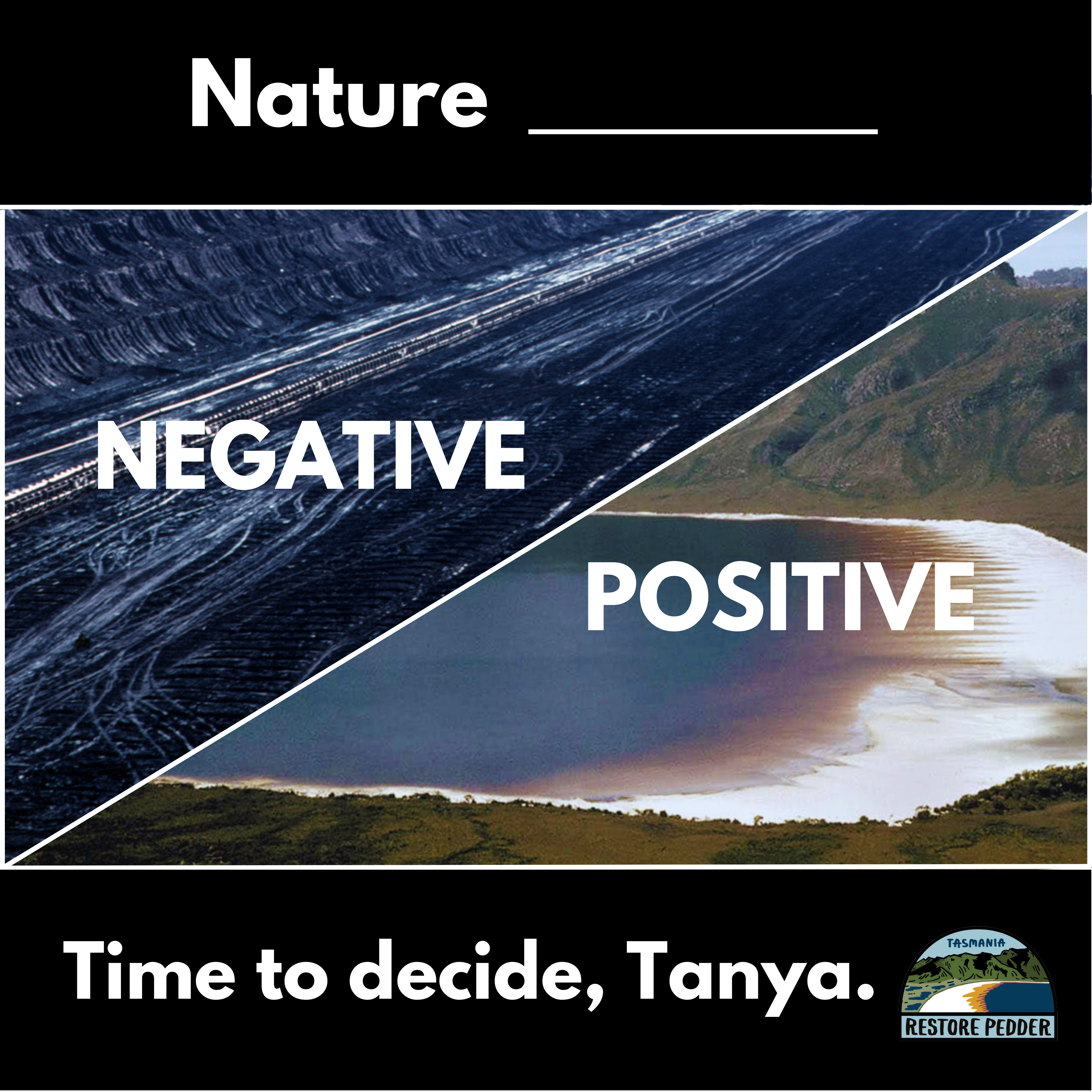
repair nature” at the Global Nature Positive Summit last week sets the stage for the
ultimate project: restoring Tasmania’s Lake Pedder.
Last week, the Federal Government “brought the world to Sydney” to showcase its
nature-positive credentials. But the Summit only highlighted a disappointing lack of
progress, leaving environmental groups in dismay.
It was a step back from Tanya Plibersek’s 2022 debut as Federal Environment Minister
when she declared that, under the Labor Government, “The environment is back as a
priority”. The Government had promised to be the first country to set clear goals for
achieving nature-positive outcomes – meaning more nature, in better health, by 2030 –
all based on the 2022 Kunming-Montreal Global Biodiversity Framework, to which
almost 200 countries have signed up. It also made ambitious commitments to overhaul
Australia’s outdated federal environment laws and create a new environmental
protection agency.
More than two years later, there has been unfortunately little progress. The Nature Positive
Summit struggled to present a clear agenda highlighting the government’s nature positive achievements, as there was not much to show. Plans to reform federal biodiversity laws have been delayed indefinitely, and negotiations on legislation to create a new environmental protection agency have stalled. Whilst there is still hope that progress may eventually be made in Parliament, in the meantime, nature is in a
serious state of decline. Twenty new species were added to the threatened species list
in September 2024, continuing a troubling trend that saw five times more species than
the yearly average added in 2023. The Summit seemed like a desperate attempt to find
solutions that could help Australia meet its biodiversity targets – scrambling to secure
private funding and rework economic frameworks to incentivize investment in nature.
Meanwhile, an incredibly low-cost, high-impact project is staring the Federal
government in the face: Lake Pedder.
In Tasmania’s Southwest, Lake Pedder was once an internationally renowned natural
jewel but was flooded in 1972 for a hydroelectric scheme. Currently submerged under
the Huon-Serpentine impoundment, Lake Pedder could be restored for a cost similar to
the ongoing maintenance required to keep on the ageing, high-risk dams that impound
it.
Lake Pedder is one of Australia’s most feasible, cost-effective, and impactful restoration projects, with high biodiversity return and strong viability.
Large-scale restoration is essential if we are to meet ambitious targets to halt
extinctions and drive ecosystem recovery. Restoring Lake Pedder would return 242
square kilometers – 24,200 hectares – of pristine wilderness to the Tasmanian
Wilderness World Heritage Area, making it one of Australia’s largest-ever restoration
efforts. For context, a recent report on Biodiversity Credit market estimates that there
have been, at the highest estimate, 125,000 hectares of positive biodiversity outcomes
which have been financed by biodiversity credits this decade.
Restoring Lake Pedder could achieve the equivalent of almost a fifth (19%) of the biodiversity gains from
all biodiversity credits, within a single project. What’s more, it would qualify as a
flagship project for the UN Decade on Ecosystem Restoration, for which the Federal
Environment Minister is yet to nominate a project to date. Initial estimates approximate rehabilitation will cost substantially less than the $150 million in upcoming maintenance works to maintain just two of the three “high-risk” dams impounding the lake.
Located within a Wilderness World Heritage Area, it faces fewer obstacles like private
land tenure or the need for small-scale conservation agreements. In fact, when the
boundaries of the Wilderness World Heritage Area were originally drawn, they were
designed with the understanding that Lake Pedder would eventually be restored once
the dams – Edgar, Scotts Peak and Serpentine had served their purpose. That time is
now – with the dams on an active fault line now dilapidated.
The area around Lake Pedder is home to 42 federally threatened species, but the lake is
currently a dead spot for biodiversity. Restoring it would put Tasmania and Australia
back towards the path of meeting its nature positive ambitions. Scientists have
described the potential for Lake Pedder to be restored as “A monumental beacon of
hope in a world which is having too many candles snuffed out.”
The Federal Inquiry into the Proposal to Drain and Restore Lake Pedder in 1995 found
that the lake’s restoration was indeed technically feasible. Convenor for the
campaign to restore Lake Pedder Christine Milne says, “the only thing holding
restoration back is political will.”
As the Australian government is struggling to find ways to step on a nature-positive
path, Lake Pedder offers the perfect solution.
 Restore Lake Pedder