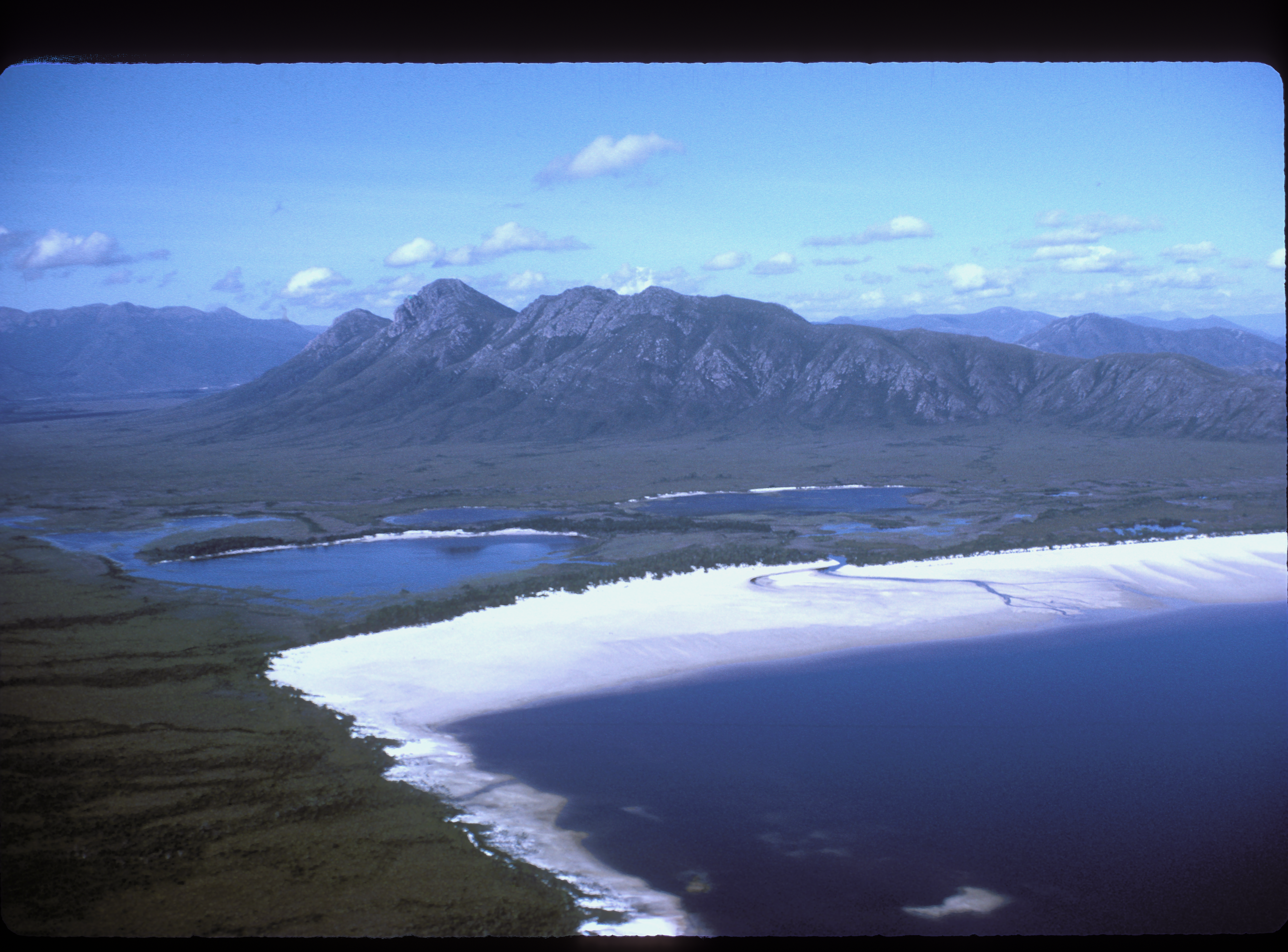
Lake Pedder and Mount Solitary, 9th April 1971, Patrick Nichols
The History
The story of Lake Pedder
The Original Lake Pedder
A place unlike any other on Earth
Lake Pedder sat in the heart of Lutruwita/Tasmania's Southwest National Park — a vast, shallow freshwater lake tinted by teatree, spread across 20 square kilometres, edged by a stunning 5-kilometre crescent of fine quartz sand. It was a place of haunting beauty: wild, remote, and ecologically unique.
The original beach was shaped by millennia of wind and water, creating a habitat found nowhere else — shallow wetlands, rare flora, and a breeding ground for endemic species. For visitors lucky enough to see it, Pedder was transformative.
The Pedder Awakening
A timeline of wonder
Lake Pedder is not just a place we lost; it is a masterpiece waiting to be revealed once more. This is the story of a million years, a long hibernation, and a re-awakening that is now within reach.
1896
- George Meredith tracks to Lake Pedder, attempting to find a route to the west, from the navigable waters of the Gordon River to its junction with the Serpentine River and Lake Pedder. Read his trip account to the Tasmanian Parliament here.
1947
- Lloyd Jones makes inaugural plane landing on Pedder’s Beach.
1955
- March 8th – SBP declared the region from Mt Sprent, Mt Gell and Mt Solitary, the Lake Pedder National Park.
1963
- The Tasmanian Government seeks Federal funding to construct the Gordon River Road.
1965
- Tasmanian Government announces Lake Pedder will be “modified”. No further details were provided until 1967.
1967
- May – Proposal to flood Lake Pedder for the creation of a Hydro-electric scheme is publicly announced.
- June – a 10,000 signature petition opposing the flooding of Pedder is presented to the Tasmania Parliament. The Middle Gordon Power Scheme Bill is introduced.
1968
- October – A South-West National Park is gazetted.
1969-1971
- 17 species, endemic to Pedder, are revealed in biological investigations.
- Olegas Truchanas and Ralph Hope-Johnstone present their audio-visual slideshow to packed audiences at the Hobart Town Hall.
1971
- Lake Pedder Action Committee is formed.
- March – 2000 people visit Lake Pedder on the long-weekend.
- December – Serpentine Dam is closed off, and the waters begin to fill.
1972
- January 6th – Ardent Lake Pedder and Wilderness campaigner and photographer Olegas Truchanas tragically drowned on his trip down the Gordon, during which he intended to photograph to save from yet another Hydro scheme.
- February – waters backing up from Serpentine only a few miles from Pedder.
- March – Surprise state election is called. The United Tasmania Group (UTG) formed as a world first ‘green’ values-based political party, opposing the flooding of Pedder. LPAC establishes a vigil on the beach.
- April 21st – Tasmanian State Election was held. UTG failed to win any seats.
- June 7th – Scotts Peak Dam is closed.
- July – LPAC presents the Premier with a 17,500 signature petition to save Pedder.
- August 1st – Attorney General Mervyn Everett resigns. Premier Eric Reece appointed himself to the role and introduced special legislation to legalise the flooding of Lake Pedder in the ‘Gordon River Doubts Removal Bill’.
- August 10th – Bill passed by House.
- August 19th – Mervyn Everett, re appointed Attorney General.
- September – Beach vigil is lost as Pedder’s dunes become an island.
- September 8th – Breanda Hean and Max Price leave in the Tigermoth intending to fly to Canberra and skywrite ‘Save Lake Pedder’ above the capital. The Plane was lost with no wreckage ever found. Evidence of sabotage was never fully investigated. The events of the disappearance remain unknown to this day.
- September 17th – Inland Fisheries Council stock the Pedder impoundment with Brown Trout against scientific advice.
- December – Labour takes Government in Canberra with Prime Minister Gough Whitlam, who requests the Tasmanian Government undertake a joint State-Federal inquiry into Pedder. Premier Reece refuses.
1973
- January – Environment minister Moss Cass succeeds in getting a Federal inquiry started. To the avail of Premier Reece.
- March – The Huon-Serpentine Impoundment merges into a single sheet of water, the largest in Australia.
- Prince Phillip (president of the Australian Conservation Foundation) visited Premier Eric Reece concerning Lake Pedder. The meeting was unsuccessful, the royal consequently writing to Prime Minister Gough Whitlam: “The Tasmanian government simply does not understand the point of conservation.”
- June – Federal inquiry submits its report, recommending the immediate stop to flooding Pedder so the possibility of saving the lake can be properly investigated with ALL expenses covered by the Federal Government.
- October – Federal cabinet accepts report but Minister Moss Cass warns “The Tasmanian Government may tell us to go jump in Lake Pedder and that would be the end of it.” Premier Reece did so the following day, at which stage Lake Pedder was almost 15m underwater.
1982
- Tasmanian Wilderness World Heritage Area is established, encompassing the Pedder Impoundment for ease of management.
1989
- IUCN urge that the long term restoration of the natural Lake Pedder be considered.
1993
- Dam removal in the US is slowly becoming a new phenomenon.
1995
- Federal Inquiry finds the restoration of Lake Pedder is “technically feasible”.
1994
- January – IUCN passes a motion that the flooding of Lake Pedder was an environmental disaster which compromised the integrity of the TWWHA. The IUCN General Assembly said that Lake Pedder’s restoration would be a symbol to the world of a determination to redress some environmental mistakes of the past, calling on the Tasmanian Government to investigate the feasibility of the restoration.
- April – Pedder 2000 campaign formally launched in Hobart by David Bellamy. Campaign branches were established in Melbourne, Sydney, Launceston, Burnie, Canberra and Adelaide.
- December – House of Representative Standing Committee Inquiry into the Proposal to drain and restore Lake Pedder announced.
1995
- Inquiry into the Proposal to drain and restore Lake Pedder finds the proposal “technically feasible”.
2015-2016
- Drought in Tasmania resulted in alarmingly low hydro lake levels.
- The BassLink interconnector fails, preventing the import of power from the mainland. Tasmania is forced to use backup diesel generators.
- As only the top metre of Pedder is diverted into the Gordon scheme (as legislated to avoid shoreline erosion, preserving the ‘natural’ looking status of the Lake as a tourism asset), a draft report is prepared by Hydro to draw the water level below that of legislation to resume producing hydro electricity.
- Decision not to use Pedder for power was made as the reservoir is invaluable to Tasmania as a tourism destination and for fishing.
2018
- Amid the Tasmanian tourism boom, Mount Field welcomed around 300,000 visitors. An hour away, Lake Pedder saw approximately 20,000.
2019
- February 17th – Restore Pedder Campaign formally launched by Christine Milne and Bob Brown as the globe faces a shift in attitudes toward our planet amid twin climate and biodiversity crises, and 2021 to 2030 declared by the United Nations the Decade of Ecosystem Restoration.
2021
- June 5th – UN officially launch the Decade of Ecosystem Restoration, for which the restoration of Lake Pedder can be a flagship project reinstating the authenticity of Tasmania’s ‘clean and green’ brand, providing regenerative recovery opportunities post pandemic and making the state a global leader in ecological restoration and wilderness stewardship.
The Case for Restoration
It can be done — and should be
The water is not gone — it sits behind dams. The sand is not gone — it lies beneath the impoundment, essentially undisturbed. Ecological surveys confirm the original beach remains intact under the reservoir silt. The restoration is physically and technically feasible.
Lake Pedder can be restored by incrementally lowering the water level and re-exposing the original beach and wetlands. Nature is resilient: given the chance, the ecosystem would begin to re-establish. This is not nostalgia — it is rewilding, grounded in science.
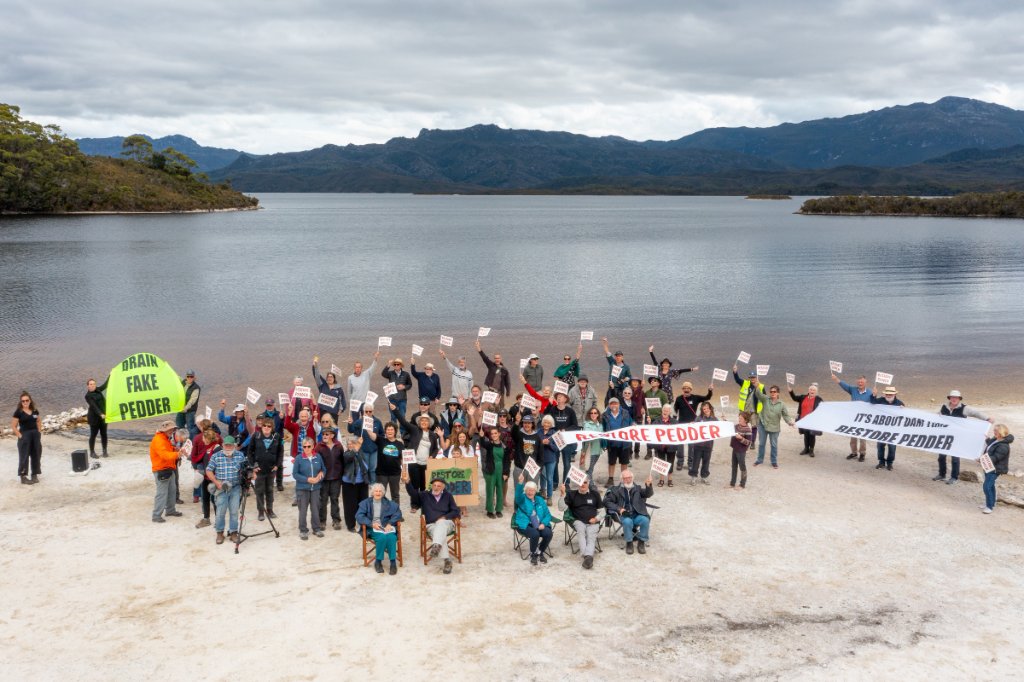
Our Mission
Restore Pedder. Restore what's possible.
We exist to build the public will and the political mandate to drain the impoundment, re-expose the original Lake Pedder beach, and restore the surrounding ecosystems — for the benefit of nature, for Traditional Owners, and for future generations.